

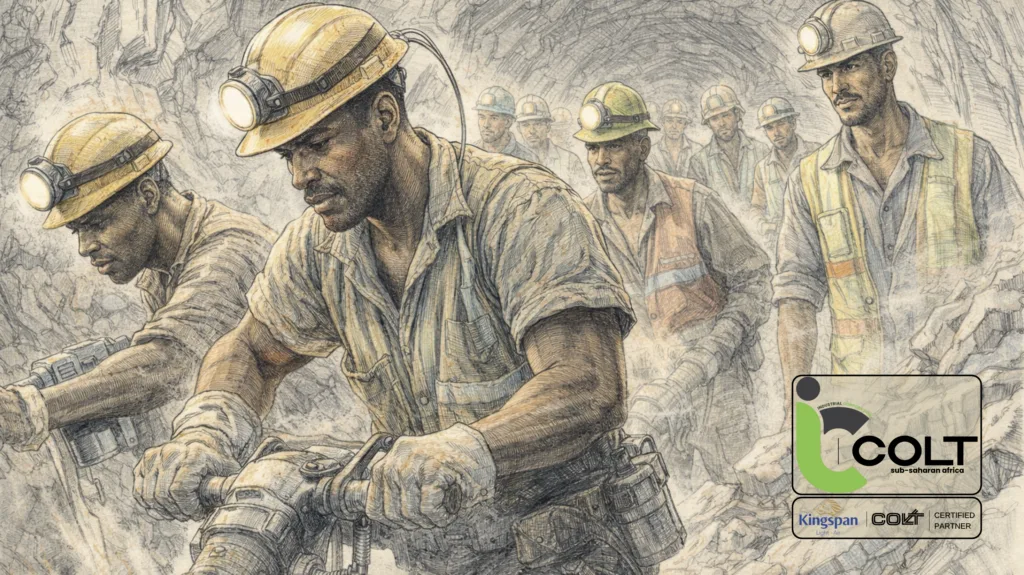

We entered the African mining sector with curiosity, practical intent, and an awareness that we did not yet have all the answers.
We were clear on what we knew, and equally clear on what we still needed to learn.
An unexpected outcome was uncovering part of our own history in the process.
Colt International has been part of South African heavy industry since the 1950s, including mining environments where performance was never optional.
Why mining is different
Mining is a sector that operates on evidence rather than assumption.
Heat, corrosion, dust, vibration, and continuous duty cycles define the environment. Systems that are designed for occasional use do not survive daily operation.
The outcome is not theoretical. It is failure over time.
A heritage we recognised
As the work progressed, patterns became clear.
Early Colt influenced installations in South African heavy industry consistently reflected:
Natural ventilation systems designed for continuous heat extraction Link here
Aluminium based construction to resist corrosion
Simple, robust designs suited to harsh environments
This was not accidental. It was engineering aligned to environment, supported through design-led application and system integration
Examples from early South African mining and heavy industry
Historical references and industry records point to applications across key mining and processing regions from the 1950s onwards, including:
Gold mining operations on the Witwatersrand, where surface plants and workshops required continuous heat and fume extraction
Mineral processing and smelting facilities in Gauteng and surrounding industrial zones, where high temperature processes drove the need for natural ventilation systems
Early platinum and base metal operations in the Rustenburg region, where corrosive environments influenced material selection and durability requirements
Typical system characteristics observed across these environments included:
Large free-area natural ventilators positioned for buoyancy-driven extraction
Weather-resistant louvre and flap configurations designed to operate reliably in normally closed conditions
Aluminium alloy construction to reduce corrosion impact and extend service life
Mechanical simplicity to reduce failure points under vibration and dust exposure
In these environments, ventilation systems formed part of operational infrastructure, supporting both worker conditions and process stability.
While specific project records continue to be verified, the recurring theme is consistent: systems were selected and configured based on performance under real operating conditions, supported by repeatable design principles.
What we learned
We arrived without a defined mining playbook.
We developed one.
Grounded in site reality. In operational behaviour. In what holds up over time.
That process brought us back to a simple observation.
Many of the fundamentals had already been addressed in earlier industrial applications.
The three control points
- Duty classification: Emergency only, or daily operation plus emergency function. In mining, dual use is common, which places higher demand on actuators, linkages, and control logic.
- Reliability class: EN 12101-2 Re-classifications aligned to actual usage. Higher cycle classifications support repeated operation without degradation.
- Verified production: Declaration of Performance and Factory Production Control aligned to the installed system, ensuring the unit supplied matches the unit tested.
- Environmental suitability: Material selection, sealing, and mechanical design aligned to dust loading, corrosion, and temperature exposure specific to mining sites.
What the field continues to show
Across mining environments, performance follows a consistent pattern.
Systems designed for durability, tested performance, and controlled installation show:
More stable operation over time
Lower maintenance intervention
Greater reliability under load
With cost driven substitutions, the pattern typically shifts:
Increased maintenance frequency
Earlier component fatigue
Variability in performance
In safety critical systems, this creates a measurable gap between expected and actual behaviour, particularly where systems are relied upon for both daily ventilation and emergency smoke control.
Operational data from industrial environments consistently shows that lifecycle performance is driven more by initial specification discipline than by post-installation correction.
The thread that connects it all
What emerged was more than history – it was continuity in engineering approach.
The same engineering discipline that defined early industrial installations is the same discipline required today.
This is not driven by brand preference.
It reflects the fact that the environment itself has not changed.
Standards alignment in practice
In practice, SANS 10400-T is often treated as equivalent to EN 12101, although the two are not directly interchangeable in terms of system testing, certification, and traceability.
EN 12101 requires system-level performance verification, including:
Tested ventilator performance under defined thermal and aerodynamic conditions
Declared performance through DoP documentation
Ongoing Factory Production Control to ensure manufacturing consistency
SANS 10400-T provides a regulatory framework for building compliance, although it does not replicate the full system verification and traceability structure defined within EN standards.
The assumption of equivalence typically arises during specification and contractor response rather than deliberate misrepresentation. The gap emerges where system performance is assumed rather than evidenced.
Over time this leads to installations that meet regulatory expectation on paper, although they do not always align with the performance assurance embedded in EN frameworks.
What this confirms
We recognised our history in the field.
And it reinforced what consistently works in these environments.
In mining, performance is proven over time.
And confidence comes from proof.
#MiningAfrica #VentilationSystems #ENStandards #FireSafetyEngineering #BuiltEnvironment #IndustrialEngineering #SustainableInfrastructure #ICColt #Kingspan #SmokeControl
IC Colt | Kingspan Light + Air | Colt International
Read more here: LinkedIN
EN WISDOM: EN standards define system-level performance.
They are supported by tested outcomes, declared through DoP documentation, and maintained through Factory Production Control.
In practice, certification language and validity periods require careful interpretation, particularly where documentation is issued “in accordance with” rather than fully aligned to system-level EN requirements.
Performance remains traceable from design through to installation and ongoing operation, with consistency between tested, certified, and installed systems forming the foundation of reliable outcomes.
Coming Next
This article forms part of our broader industry storytelling on standards, performance, and lifecycle accountability.
Next in the series: The early automotive industry in South Africa, where ventilation and environmental control became part of production performance, local case study of where it goes wrong
About IC Colt (Pty) Ltd : IC Colt is the certified Sub-Saharan partner to Colt International. The company specialises in fire safety, sustainable ventilation systems, and EN-compliant solutions tailored for public infrastructure, commercial buildings, and industrial facilities.
IC Colt | Colt International | Kingspan Light + Air
 Media inquiries: press@icorpgrp.com–
Colt in African Mining, heritage to modern EN strategy
Colt’s heritage in South African mining since the 1950s shows how performance-led ventilation stands up to heat, dust, and continuous...

ISO is not EN FPC: Why Factory Production Control Matters
ISO 9001 confirms how a company manages quality. EN certification with Factory Production Control confirms that a life safety product...
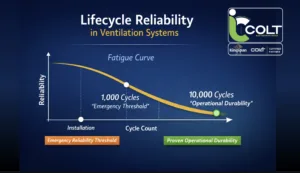
Lifecycle Reliability: Why Cycle Testing Matters
Smoke and heat control systems may sit above a building for years before they are ever needed. When a fire...